
North Ogden City Directory Holdings
The local collection is regional by design. The Weber library catalog lists R.L. Polk Ogden city directories from 1895 to 1928, Polk’s Ogden directories from 1929 to 1939 and 1940 to 1942, and later editions that explicitly include North Ogden, Roy, South Ogden, and Washington Terrace. The listed North Ogden-inclusive runs are 1974 to 1984 and 1986 to 2009, followed by an Ogden Polk run from 2011 to the present. Each volume still needs a page-level check.
| Collection | Years located | Where held | Access |
|---|---|---|---|
| Polk Ogden directories | 1895 to 1928 | Weber library catalog and resources | Check volume and locality |
| Polk’s Ogden directories | 1929 to 1939 | Catalog and linked runs | Availability varies |
| Polk’s Ogden directories | 1940 to 1942 | Catalog and Special Collections | Regional context |
| Ogden volumes including North Ogden | 1974 to 1984 | Stewart Library holdings | Physical or digital check |
| Ogden volumes including North Ogden | 1986 to 2009 | Weber catalog | Verify each edition |
| Digitized Polk collection | Collection description 1870 to 1987 | Stewart Digital Collections | Public scan or OCR where digitized |
The catalog lists physical holdings at Stewart Library Special Collections, call number 979.228 R62723, and notes that those books are not for loan. Ask staff which year is on the shelf before making a trip. A directory collection can be broad while the North Ogden heading appears only in selected editions.
North Ogden Polk Directory Years
The Weber library catalog record is the best starting point for the physical directory trail because it names the runs and links related resources. Weber Public Library’s Main Library at 2464 Jefferson Avenue in Ogden offers microfilm and local research help. Stewart Library Special Collections and University Archives at Weber State are the stronger stop for physical Polk volumes, digitized directories, photographs, oral histories, and finding aids.
Some access is in-library. The library reports a digital microfilm reader with scans and prints. Its newspaper service also identifies Utah Newsearch, Utah Digital Newspapers, and microfilm. Ask about the exact year and title, since a search result or catalog line does not guarantee that a scan can be downloaded from home. These access differences are part of how a North Ogden city directory should be cited.
Reading a North Ogden City Entry
The digitized 1883 directory page offers a close look at the older format. Sample entries include Samuel J. Allen, book-keeper, tied to J. W. Lowell and a street between Young and the numbered streets; Daniel Alexander, insurance agent and broker, on First between Main and Young; and Andrew Anderson, laborer, on Third between Spring and Smith. Other entries use a corner, an employer, or a hotel as the location clue.
| Name | Printed surname, given name, initials, or an abbreviated form. |
|---|---|
| Role | Occupation, employer, firm, or institution when supplied. |
| Address | Street, corner, between-street wording, or lodging reference. |
| Household clue | Spouse in parentheses or italics, prior-year death, or forwarding note in some volumes. |
“Bet.” means between and “cor.” means corner. OCR may miss punctuation or split names, so inspect the scanned page before copying. Earlier Ogden-area volumes can use county, township, or post-office labels. A North Ogden city directory entry should preserve the printed locality and then explain any modern match separately.
- Criss-cross directory
- An address-first volume that lets a researcher work from a street to a listed household.
- Head of household
- The person selected for the alphabetical entry, not every person in the home.
- Abbreviation key
- The publisher’s guide to shortened streets, occupations, firms, and address terms.
- OCR
- Machine-read text from an image, useful for discovery but weaker than the page scan.
North Ogden Directory Scans Need Checks
Stewart’s digitized collection gives the North Ogden city directory a useful online path. The broader description spans 1870 to 1987 and says entries may include alphabetical household heads, street address, occupation, spouse, prior-year deaths, firm partners, forwarding address, or post-office notes. The digital search page shows examples from 1878, 1883, 1884, the 1900s, and later years. Exact North Ogden availability still depends on the volume and locality heading.
Search OCR for a surname, then open the page image. Try initials, alternate spellings, the street, and the between-streets phrase. Save the collection name, volume year, page, and link. A directory is a dated publication. It may omit a household, lag a move, list a spouse, or retain an old address after a change. Those limits do not make the source weak, but they do define what the city directory can say.
Note: Treat “listed at an address in a publication year” as the finding; do not recast it as current occupancy.
North Ogden Newspapers Fill Gaps
Weber Public Library’s newspaper page reports Ogden Standard-Examiner and predecessor microfilm from 1870 to the present. Ogden Newspapers digitized coverage from November 10, 1881 through December 31, 1977 is available in the library, and Utah Newsearch covers Standard-Examiner and other Utah articles and obituaries from 2005 forward. Utah Digital Newspapers contains more than 300 historic papers, including 24 Weber County titles from Ogden, Roy, North Ogden, and Ogden Valley.
The library notes Standard-Examiner gaps from 1920 through 2002. A missing obituary or public notice therefore needs a second route, such as microfilm, another title, a county record, or an archive. Newspapers can bridge a city directory year with a marriage, sale notice, public meeting, obituary, or address reference. They cannot turn every mention into proof of residence or title.
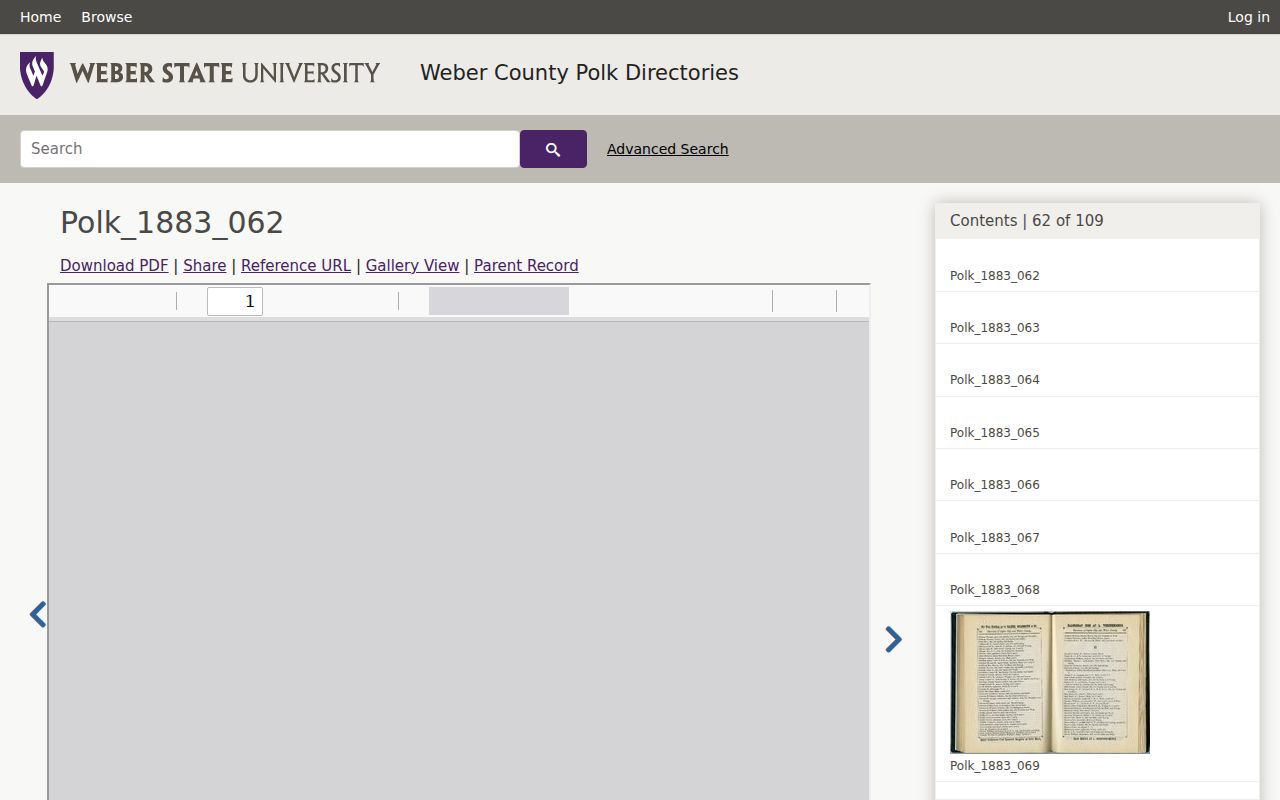
The library catalog image source shows why the shelf and the digital link should be cited together.
That catalog context helps a researcher choose the right volume before reading a North Ogden entry, especially when the book is held in Special Collections and is not for loan.
North Ogden Census Directory Clues
The Utah State Archives Weber County 1850 census index is an early companion to the city directory. It supplies names, gender, age, birthplace, occupation, and links to image pages from the first federal enumeration of Weber County and Utah Territory, copied in 1851. It is not a modern North Ogden roll. Historic county names and boundaries do not always map cleanly to today’s city.
Use the index as a baseline for family research, then read the linked image and compare later directory, deed, newspaper, or cemetery evidence. The State Archives research gateway also points to county birth registers, probate and court registers, municipal indexes, and digital finding aids. Some underlying records require a reading-room visit or reproduction request.
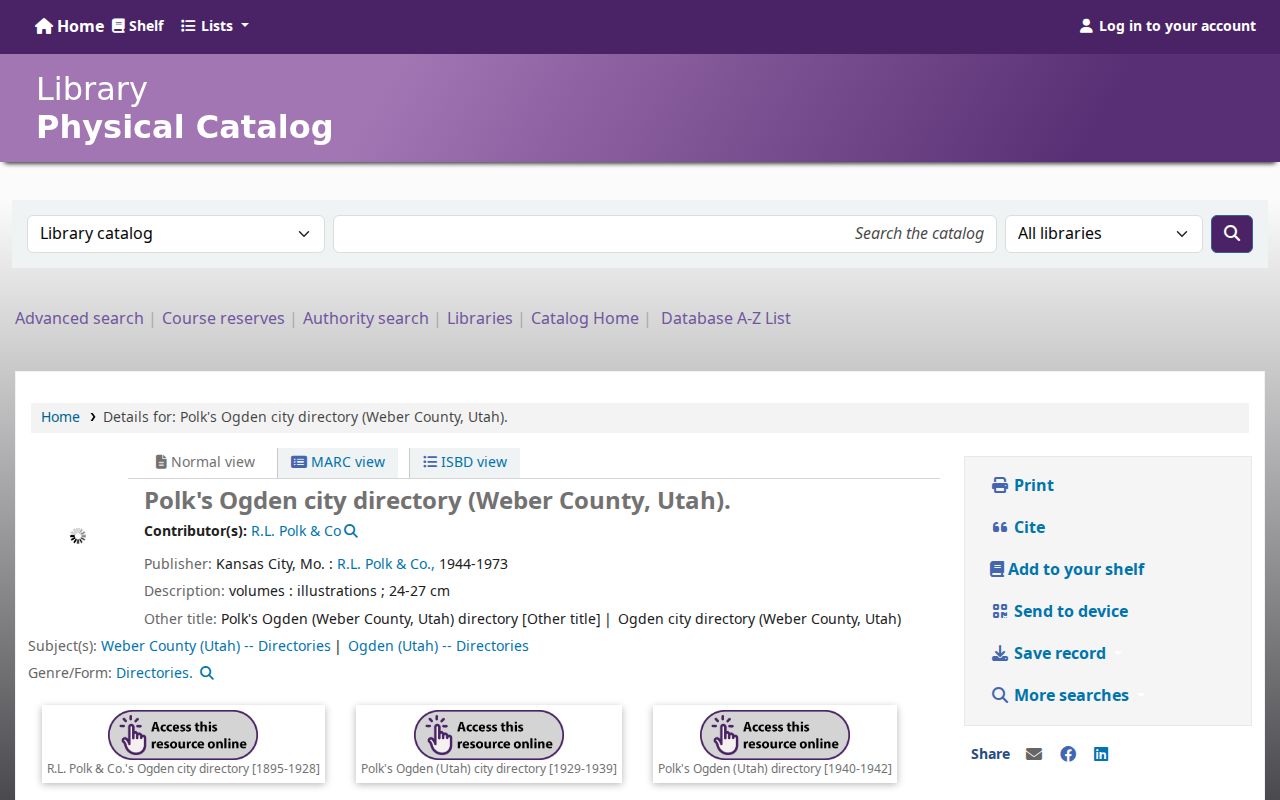
The digitized page source shows the compressed street language that makes a scan important.
Image review is the safest way to keep initials, “bet.”, “cor.”, and lodging notes from being flattened into modern address prose.
North Ogden Council Minutes
The Utah Archives finding aid for North Ogden council minutes covers 1934 through 1999. These minutes can expose civic names, appointments, land-use decisions, public events, and public comments by meeting date. They are a municipal chronology, not a citywide city directory. A person in an agenda may be an official, applicant, petitioner, consultant, or commenter and may own property somewhere else.
North Ogden Public Notice Web adds current meeting notices, agendas, minutes, audio, and contact metadata. A July or August 2025 notice shows the pattern: meeting location, contact person, agenda links, minutes or audio, and accommodation or remote-access details. Save the notice date and role when using a municipal name as historical context.
- 1850: Weber County census index supplies an early baseline.
- 1883: A digitized Ogden and Weber County directory shows compressed street entries.
- 1895 to 1942: Polk Ogden runs form an early cataloged shelf.
- 1934 to 1999: North Ogden council minutes preserve a local civic trail.
- 1974 to 2009: Later cataloged volumes explicitly include North Ogden.
- 2011 to present: The catalog lists a later Polk Ogden run.
North Ogden Cemetery Records Trail
For a former resident, the cemetery record can be a useful endpoint. Ben Lomond Cemetery at 526 E 2850 N was established in 1851. The local name changed from Union Cemetery to North Ogden Cemetery and then Ben Lomond Cemetery. The office can locate deceased people during its published limited weekday hours. This naming trail matters when an obituary, directory, deed, or family paper uses an older term.
The state Cemeteries/Burials search supports first and last name, death-year range, cemetery, county, and city fields. The Archives cemetery guide warns that many cemetery records are not indexed by name. Use the cemetery office, state search, obituary, and directory together, and avoid exposing details about living relatives.
North Ogden Regional Directory Shelves
Stewart Library’s “Ogden’s Crossroads” collections add photographs, oral histories, business records, newspaper clippings, immigrant histories, and finding aids. The Heritage Foundation at 2580 Jefferson Avenue in Ogden has a Home Marker program for houses at least 75 years old. Neither institution is a complete North Ogden resident index. Their strength is context around a name, street, building, or family lead.
Regional records can mention North Ogden while using an Ogden-area heading. Weber County was created in 1850, and the county’s boundaries changed over time. A source’s locality label, publication year, and record type must stay visible. When a directory entry needs a modern address match, the street-level parcel and deed process belongs on the North Ogden street directory page. When it needs a present-day person match, use the resident lookup route.
Trace North Ogden Directory Years
A city directory becomes more useful when paired with a census, deed, newspaper, or cemetery source. The goal is not to force continuity. The goal is to record what each year actually says and mark the gaps. Start with the known surname, street, or family member. Then test nearby years and old locality terms.
- Write the household name, alternate initials, street wording, and target year.
- Search the library catalog and Stewart digital collection for the volume, then inspect the image.
- Record the printed address, occupation, spouse or head-of-household marker, page, and locality heading.
- Compare the nearest census, deed, newspaper, council, or cemetery record without changing the original field label.
- Grade the result as a scanned listing, index lead, recorded instrument, or unresolved clue.
The same household may appear under a spouse, a firm, a hotel, a changed street name, or no entry at all. A 1883-style between-street address may not convert cleanly to a modern North Ogden number. Keep the printed wording and explain the interpretation. That is how a city directory supports family history without becoming a made-up resident roll.